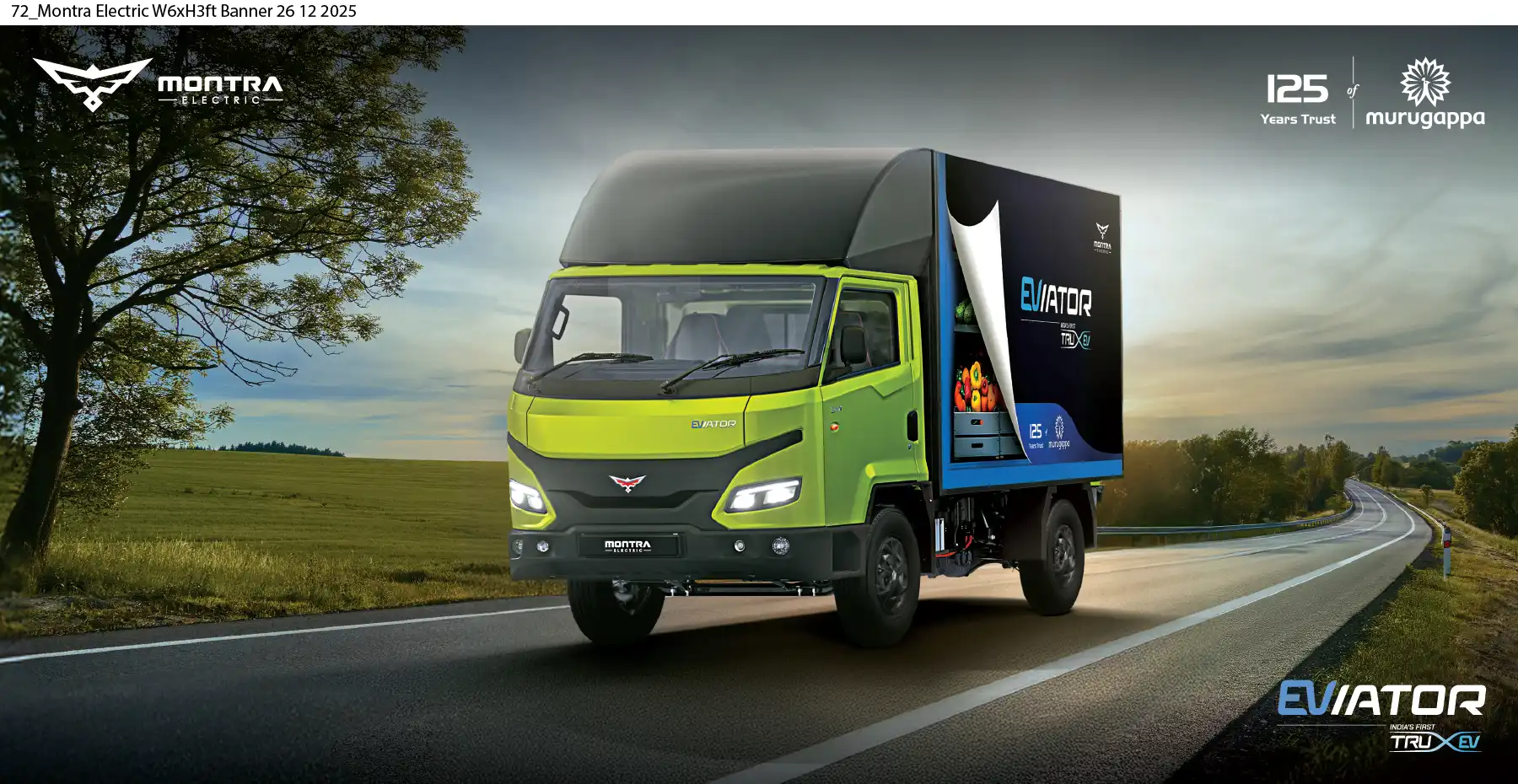
Fleet operators in India are moving to electric commercial vehicles because the economics finally make sense. Lower running costs, predictable charging expenses, policy-backed incentives, and more reliable EV technology have pushed fleets to adopt electric trucks, vans, and small commercial EVs at scale. The shift is no longer experimental. It’s a practical operational choice for businesses looking to reduce costs and stay future-ready.
It’s a decisive phase for India’s fleet and logistics sector. Fuel price volatility, stricter emission regulations, and growing sustainability mandates are forcing operators to reassess long-term vehicle strategies. In 2025, that reassessment is increasingly resulting in adoption. Across urban and regional networks, fleets are switching to electric commercial vehicles in India, as the economics, technology, and policy environment are finally aligned. What was once a cautious experiment has become a practical operational choice.
Electric commercial vehicles in India have crossed an important threshold. Adoption is no longer limited to pilot fleets or niche use cases. The electric truck in India, electric vans, and small electric commercial vehicles are now operating across logistics, FMCG distribution, construction support, and municipal services.
This shift reflects improved product readiness and expanding infrastructure coverage. Battery ranges are more predictable, charging availability is improving along freight corridors and within urban depots, and fleet operators now face fewer unknowns. Deployment of the electric truck in India for intra-city and short-haul routes has moved from trials to scaled operations.
For fleet operators, cost efficiency is synonymous with survival. Electric commercial vehicles in India bring cost benefits right where it hurts most: at the bottom line.
Diesel vehicles have high and variable fuel costs. Maintenance costs increase as the engine wears down, oil needs changing, and transmissions need repairing. Electric vehicles eliminate most of these factors. Electricity is a more stable cost. Drivetrains are less complicated. Downtime decreases.
This difference becomes significant over the lifecycle of the vehicle. Fleets that run an electric truck in India on controlled routes are showing reports of a lower cost per kilometer and improved budget predictability. Savings become more significant with greater fleet size. That is not a future promise, but it is a present calculation.
India's cities have very unfavorable operating conditions: congestion, frequent stops, narrow time windows for delivery, and emission-related operational restrictions—in all these areas, electric commercial vehicles India are at an advantage over diesel fleets.
Instant torque supports frequent start-stop cycles. Regenerative braking improves energy efficiency. Quieter operation allows for flexibility in delivery timings. These are especially relevant for last-mile and mid-mile logistics.
This is why the electric truck in India is increasingly getting assigned to high-density routes where the utilisation is high and distances predictable. Some of the OEMs, including players like Montra Electric, have focused on building electric commercial vehicles for such a duty cycle rather than adapting passenger EV platforms. In any case, that alignment between the design of the vehicle and on-road use is accelerating its adoption.
For large fleet operators, sustainability is not an option. Corporate customers trace supply-chain emissions, regulators enforce more compliance, and urban authorities ban or restrict traffic that is polluting.
This is where electric commercial vehicles in India directly address these pressures. Zero tailpipe emissions reduce local pollution, while the ability to more easily access regulated zones and future-proof operations is key for fleets that electrify.
Electrification will be a base expectation for logistics providers serving enterprise clients. It also underpins the wider ESG reporting, which is increasingly a driver of contract awards and access to capital. While important, the environmental benefit now links with business continuity.
Government policy still plays a crucial role. Central and state-level EV policies combined with incentives under FAME and local programs have reduced the acquisition cost of electric commercial vehicles India.
Charging infrastructure has expanded steadily. Public fast-charging networks are growing, private depot charging is already standard for large fleets, and utilities are introducing EV-specific tariffs further improving operating economics.
This is a policy-backed ecosystem that reduces adoption risk. In the year 2025, fleet operators are less concerned about being early, but more so about being late to deploy the electric truck in India at scale.
Earlier concerns around battery degradation, charging downtime, and reliability are easing. Battery warranties are clearer, telematics provide real-time performance data, and predictive maintenance tools are improving uptime.
Localization is also fast increasing in electric trucks in India. The manifold manufacturers are now designing the vehicles around Indian payload requirements, road conditions, and climatic variations. This localization improves consistency and reduces operational surprises.
Brands like Montra Electric, among other domestic OEMs, echo this trend through their concentration on India-specific commercial EV platforms and away from imported templates. For fleets, all this means a signal of maturity, not novelty.
In fact, many fleet operators are turning beyond partial adoption. Rather than operating mixed fleets indefinitely, they are planning for phased electrification using electric commercial vehicles India as core assets.
Routes get optimized for charging schedules. Depots are upgraded to include energy management systems. Driver training adapts to new regenerative braking and torque characteristics. Fleet software integrates energy usage alongside mileage.
This is a system-level approach that multiplies benefits. Fleets for which electric commercial vehicles are a core asset, rather than an add-on, achieve higher utilization and faster returns. The transition is, therefore, strategic and not incremental.
With the increasing choices on offer, the selection of the best electric commercial vehicles in India becomes dependent on operational fit. Range, payload, service support, and total cost of ownership remain key differentiators rather than headline specifications.
After-sales capability, charging compatibility, and data transparency have become important checkpoints among fleet buyers. The electric truck in India will be gauged by uptime—not novelty.
It is matured enough whereby informed decisions in it are based on data-driven insights.
Fleet electrification in India is no longer driven by uncertainty or experimentation. It is driven by results.
The best electric commercial vehicles in India are now reducing costs, improving efficiency, and supporting regulatory compliance, hence reshaping how logistics fleets will plan, operate, and grow in the future.
By 2025, those fleets that switch are behind no trend curve. They will be adapting to a new operating reality, one that will be quieter, cleaner, and structurally more efficient. And that shift is only gaining momentum.
1. Is 2026 the right time for fleets to invest in electric commercial vehicles in India?
Yes. By 2026, technology maturity, policy support, and charging infrastructure have aligned, making electric commercial vehicles a practical and scalable choice for fleet operators.
2. How cost-effective are electric commercial vehicles compared to diesel fleets?
Electric commercial vehicles offer lower cost per kilometre due to stable electricity prices, reduced maintenance, fewer moving parts, and lower downtime compared to diesel fleets.
3. How do electric commercial vehicles support sustainability and ESG goals?
They produce zero tailpipe emissions, reduce urban pollution, help fleets meet regulatory requirements, and support ESG reporting, which is increasingly linked to contracts and funding.
4. What types of electric commercial vehicles are available in India today?
Montra Electric offers a range of India-specific electric commercial vehicles, from urban and regional-duty trucks to heavy-duty electric trucks like the Montra Electric Rhino, built for high payloads and demanding fleet operations.

.svg)


.png)