Feature Snippet
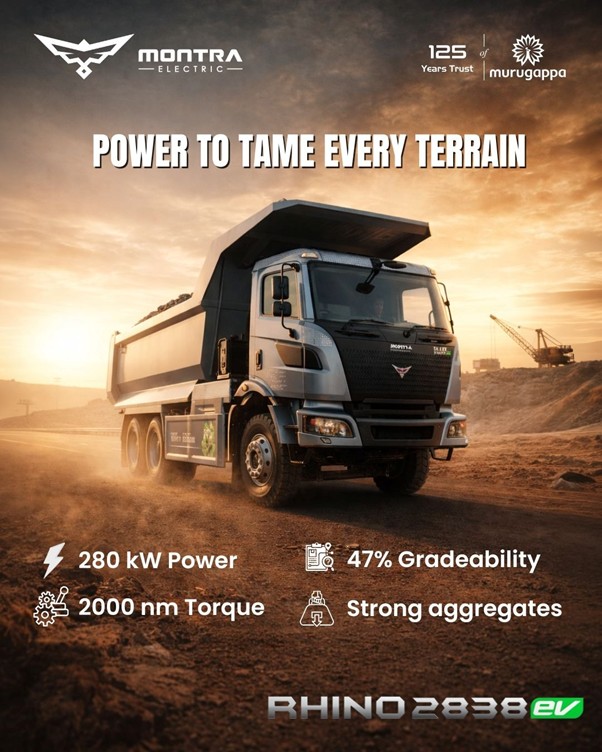
The Montra Electric Rhino 2838 EV is India's first commercially available 28-tonne electric tipper. Designed for demanding mining and construction environments, it features a 6x4 configuration and a robust 16,000 kg payload capacity. Powered by a thermally stable 282 kWh LFP battery, it delivers 280 kW of power and 2,000 Nm of torque. This enables an impressive 47% gradability, ideal for steep haul roads. Offering fast charging in 60 minutes and up to 70% lower operational costs compared to diesel equivalents, the Rhino 2838 EV combines heavy-duty performance with superior economic efficiency.
Until recently, the electric tipper truck segment in India was largely theoretical. A few concept reveals, some pilot deployments, nothing at serious commercial scale in the heavy category.
The Montra Electric’s all new Rhino 2838 EV 4x2 tipper changed that. The Rhino 2838 EV is a 6x4 configuration built specifically to suit mining, quarry (Crusher, boulders), construction material, earth work, coal, minerals & ores. It carries 28 tons GVW, delivers 2,000 Nm of torque and 280 kW of power which make is capable with 47 % gradability.
That last number matters on construction sites. A 47 % grade is steeper than most haul roads in Indian mining and quarrying operations. The truck is not a concept — it is available for commercial deployment today.
The payload concern is the first thing construction fleet operators raise. A diesel tipper in the 28-tonne GVW category is a known quantity. The question is whether an electric heavy commercial vehicle in the same class carries the same load without compromising cycle times.
The Rhino 2838 EV answers this directly. 16,000 kg payload, available in 18 & 16 cubic metre box body and 16 & 14 cubic metre rock body configurations. The 6x4 drivetrain handles the weight distribution that heavy construction and quarrying loads demand.
Because the electric drivetrain delivers peak torque from zero RPM — not at the top of a rev range — it handles gradient starts under full load better than diesel equivalents that need momentum to climb. On steep haul roads, that difference is felt in every loaded ascent. The clutchless AMT gearbox removes the gear and clutch fatigue that diesel drivers deal with on multi-trip intra-site operations. Drivers report being less tired at the end of a shift — which on a construction site running two or three shifts is a real productivity variable, not just a comfort feature.
This is the part that deserves an honest answer rather than a promotional one. Most construction sites in India do not have DC fast charging infrastructure ready to go. Installing a 60 kW or higher DC charger at a remote quarry or greenfield site requires grid connection, civil work, and upfront investment.
The practical approach operators are using: deploy the charger as part of the site setup — the same way a diesel operator sets up a fuel tank and pump. The Rhino 2838 EV supports 240 kW fast charging and charges fully in approximately 60 minutes. On multi-shift construction sites where trucks return to a central point at shift change, that window is usually available without disrupting operations.
For sites running continuous three-shift cycles with no downtime window, Montra's battery swapping infrastructure — with a 7-minute swap time — provides the equivalent of a refuel stop. As swapping infrastructure expands along mining and construction corridors, this constraint will shrink further.
The infrastructure question is real. It is also solvable, and the operators who have set up on-site charging find that the one-time setup cost recovers itself quickly against daily fuel savings.
Durability in Dust and Heat: Built for Indian Conditions
Electric trucks in India operate in conditions most global EV benchmarks don't account for — summer temperatures crossing 45°C, heavy dust ingress on unpaved haul roads, voltage fluctuations on remote grid connections, and the physical stress of maximum payload on rough terrain across multiple shifts.
The Rhino 2838 EV uses a 282 kWh Lithium Iron Phosphate battery. LFP chemistry was chosen for thermal stability and cycle life in high-temperature environments. It handles heat better than other lithium chemistries and degrades more slowly under the repetitive deep-cycle use a construction tipper sees every working day.
The powertrain is assembled at Montra's Manesar facility through an in-house battery assembly process — the only heavy truck OEM in India with this capability. Battery thermal management is calibrated for Indian operating temperatures. The chassis and drivetrain are engineered for off-road applications — strong aggregates, robust driveline, ABS braking — not adapted from an on-road platform.
The broader Rhino fleet has covered over 22 million kilometres on Indian roads across steel, cement, mining, and port applications. These are not gentle routes. That operational history is the durability evidence.
For an electric tipper truck running intra-site and short-haul construction routes, the operating cost advantage over diesel is consistent and significant.
Energy cost per kilometre for the Rhino runs ₹1.00 to ₹1.50 versus ₹7 to ₹9 per kilometre for a diesel tipper on fuel alone. Maintenance costs run 40 to 60 percent lower — no engine oil, no DPF servicing, no exhaust system, fewer moving parts overall. Montra's own data puts the total operational cost saving at up to 70 percent compared to diesel across the vehicle's operating life.
For a 10-tipper construction fleet running 80 to 100 km of intra-site and short-haul daily, the annual saving on fuel and maintenance over diesel runs into crores. The upfront premium over a diesel tipper in the same GVW class is real — but on high-utilisation construction and mining applications, it recovers within the first year of operation for most fleet configurations.
India's infrastructure procurement policies are moving consistently toward lower-emission equipment. Several large public infrastructure developers and mining companies have set internal ESG targets that make diesel-only fleet expansion increasingly difficult to justify. State-level green procurement mandates for public infrastructure projects are already requiring contractors to show a transition plan toward low-emission equipment.
The electric heavy commercial vehicle segment in India is at an early but accelerating stage. The Rhino 2838 EV is the only 28-tonne electric tipper in commercial availability today in India. For construction and mining operators making equipment decisions with a five to seven year horizon, the policy, economics, and technology are all pointing in the same direction.
For fixed-route intra-site and short-haul construction and mining applications — yes. The Montra Rhino 2838 EV handles the payload, the gradability, the heat, and the dust. It costs significantly less per kilometre than diesel from the first day of operation. It needs on-site charging infrastructure, which is a one-time setup investment that pays back within months.
For long inter-city haul routes on unplanned corridors without a charging strategy — not yet. That window is closing as infrastructure expands, but it is an honest constraint today.
The construction and mining operators moving to electric tippers now are not doing it as a sustainability exercise. They are doing it because the operating economics on high-utilisation fixed routes make diesel increasingly hard to justify.
FAQ’s
1. What is the load capacity and vehicle configuration of the Rhino 2838 EV?
It's a 28-tonne GVW electric tipper in a 6x4 configuration with a 16,000 kg payload. Available in 18/16 cubic metre box body and 16/14 cubic metre rock body options. Suited for mining, quarry, construction, coal, and ore work.
2. How does the Rhino 2838 EV handle steep inclines at construction and mining sites?
With 280 kW power and 2,000 Nm torque, it manages 47% gradability—steeper than most haul roads. Peak torque from zero RPM means it climbs loaded gradients better than diesel. The clutchless AMT also cuts driver fatigue.
3. How long does it take to charge, and are there alternatives if continuous operation is needed?
It supports 240 kW fast charging and fully charges in about 60 minutes. Trucks can top up during shift-change breaks on multi-shift sites. For non-stop operations, battery swapping offers a 7-minute alternative.
4. Is the vehicle's battery capable of surviving extreme Indian weather and dust?
Its 282 kWh LFP battery is built for thermal stability above 45°C and long cycle life. Thermal management is tuned for Indian conditions, with a chassis engineered for dust and rough terrain. The Rhino fleet's 22 million-plus kilometres prove its durability.
5. How much money can fleet operators save by switching from diesel to the Rhino 2838 EV?
Energy costs run ₹1.00–₹1.50 per km versus ₹7–₹9 for diesel, with maintenance 40–60% lower. Montra puts total savings at up to 70% over the vehicle's life. The upfront premium typically pays back within the first year.

.svg)


.png)