Feature Snippet
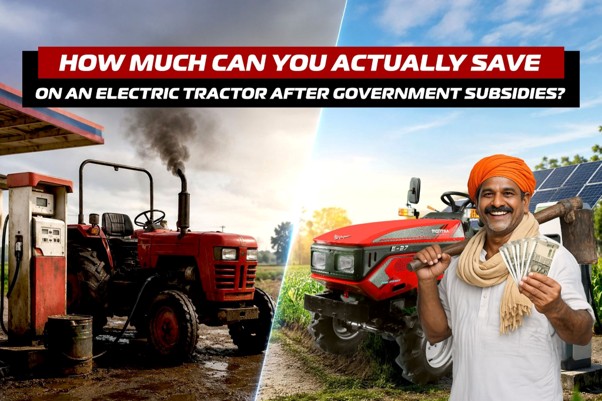
In 2026, farmers in India can reduce the cost of an electric tractor by ₹1.5 lakh to ₹7 lakh through government subsidies. While central schemes like PM E-DRIVE offer significant rebates, states like Haryana provide up to 50% or ₹5 lakh in additional support. Beyond the purchase price, electric tractors offer massive operational savings, costing only ₹40–₹80 per hour to run, compared to ₹250–₹400 for diesel tractors.
Electric tractors in India are no longer just an emerging idea. They are slowly becoming a practical choice for farmers who want to reduce their daily costs and improve long-term savings. At first glance, the price of an electric tractor may look higher than a diesel one and that is where most doubts begin. However, the real cost is not the price you see at the showroom. The actual cost comes down significantly once you include the electric tractor government subsidy and other financial benefits available in 2026.
To understand the real savings, it is important to look at the full picture. This includes the base price, government subsidies, financing support and the running cost difference over time. When all these factors come together, the economics of electric tractors in India start to look much more favourable.
In India, the current electric tractor price falls between ₹6.5 lakh and ₹12 lakh. This pricing disparity comes from the tractor's power, battery life and intelligent features. More powerful and efficient tractors will inevitably have higher costs.
The Montra electric tractor has been designed considering the agricultural requirements of India. Its main aim is to offer excellent performance with optimal efficiency. Although the initial investment seems expensive in comparison to that of a diesel tractor, it is important to remember that such a direct comparison does not consider subsidies.
For example, in 2026, there are many initiatives from the government towards encouraging electric mobility in farming. These incentives can be availed at multiple levels and together, they make up for a huge amount saved. The federal level incentives such as the PM E-DRIVE scheme and other policies aimed at promoting EVs are starting to provide for electric machinery as well. The farmer will get advantages in terms of low GST rates, incentives for using electric machines and incentives for adoption of new technologies. These would generally save him around ₹50,000 to ₹1.5 lakh.
However, state-level subsidy plays an important role in lowering the cost of electric tractor purchase. Currently, Haryana provides the most competitive subsidy package in the country. Under this scheme, farmers receive subsidies ranging from 50% to ₹5 lakhs on the cost of their tractor. Therefore, farmers will need only ₹5 lakhs for purchasing a tractor worth ₹10 lakhs.
Similarly, other states such as Punjab, Maharashtra and Uttar Pradesh are also subsidizing the purchases of electric tractors in India through various agricultural and electric vehicle policy initiatives. These subsidies range from ₹50,000 to ₹2 lakhs.
To clearly understand the savings, let us take a practical example using a Montra electric tractor.
This example shows how a tractor that initially costs ₹10 lakh can come down to around ₹3 lakh to ₹5 lakh depending on the location and eligibility. This is a major reduction and changes how farmers look at electric tractors.
While the main benefit of using electric tractors is the subsidy, there is another key benefit that needs to be considered. While diesel tractors need regular fuel and fuel prices have increased over time, electric tractors cost from ₹40 to ₹80 per hour. In contrast, diesel tractors cost ₹250 to ₹400 per hour.
Thus, if one operates the tractor for 800 to 1000 hours each year, the annual savings would come to ₹1.5 lakh to ₹2.5 lakh. The accumulated savings will be substantial enough to repay a significant portion of the tractor’s purchase price within several years.
The electric tractor subsidy scheme requires the farmer to fulfill certain conditions before qualifying for the subsidy. The first condition entails having farmer registration credentials, a land document that proves ownership/lease and a bank account linked to Aadhar.
The farmer should procure the tractor from a registered dealer and ensure the model is included in the list of approved models under the scheme. If one resides in Haryana, he/she needs to be a resident farmer and submit their application through the agricultural department website. There may be restrictions on the number of tractors procured by each farmer.
Currently, all the applications for subsidies are processed electronically. The process involves creating an account on the state website, selecting the appropriate scheme, uploading the necessary documents and applying for permission to purchase the tractor.
Initially looking at the price alone, electric tractors might appear quite costly. However, when one considers the subsidies offered by the government in addition to lower operational costs, the entire story changes completely. In such states as Haryana, for instance, where the conditions are favorable, the final cost of an electric tractor is just a little bit higher compared to the diesel tractors. Thereafter, the benefits continue each year because of lower operational costs. Buying an electric tractor in India is not just a move towards innovation but towards smart finances as well. With the use of a Montra electric tractor, the dream becomes reality.
1. What is the maximum subsidy available for electric tractors in India?
In 2026, farmers can save ₹1.5 lakh to ₹7 lakh through combined central and state subsidies. Haryana leads with up to 50% or ₹5 lakh off the purchase price. Other states like Punjab, Maharashtra, and UP offer ₹50,000 to ₹2 lakh in additional support.
2. How much can I save on fuel by switching to an electric tractor?
Electric tractors cost only ₹40–₹80 per hour to run, versus ₹250–₹400 for diesel. This adds up to annual savings of ₹1.5 lakh–₹2.5 lakh for most farmers. Over time, these savings can recover a large part of the tractor's purchase cost.
3. What documents are required to apply for the electric tractor subsidy?
You'll need farmer registration credentials, land ownership/lease documents, and an Aadhaar-linked bank account. The tractor must be bought from a registered dealer with an approved model. Applications are submitted online via your state's agricultural department portal.
4. How long does the battery last on a single charge?
The Montra Electric E-27's 22.32 kWh battery delivers 5 to 5.5 hours of continuous operation. That's enough to cover a full day of scheduled farming tasks. Charging is simple and keeps the tractor ready for the next day's work.
5. Are electric tractors powerful enough for heavy-duty tasks?
The Montra E-27 offers 27 HP, 90 Nm torque, and 720 kg hydraulic lifting capacity — built for real farm work. Instant electric torque provides strong pulling force even during heavy-duty operations. Farmers get full diesel-level performance with zero compromise.

.svg)


.png)