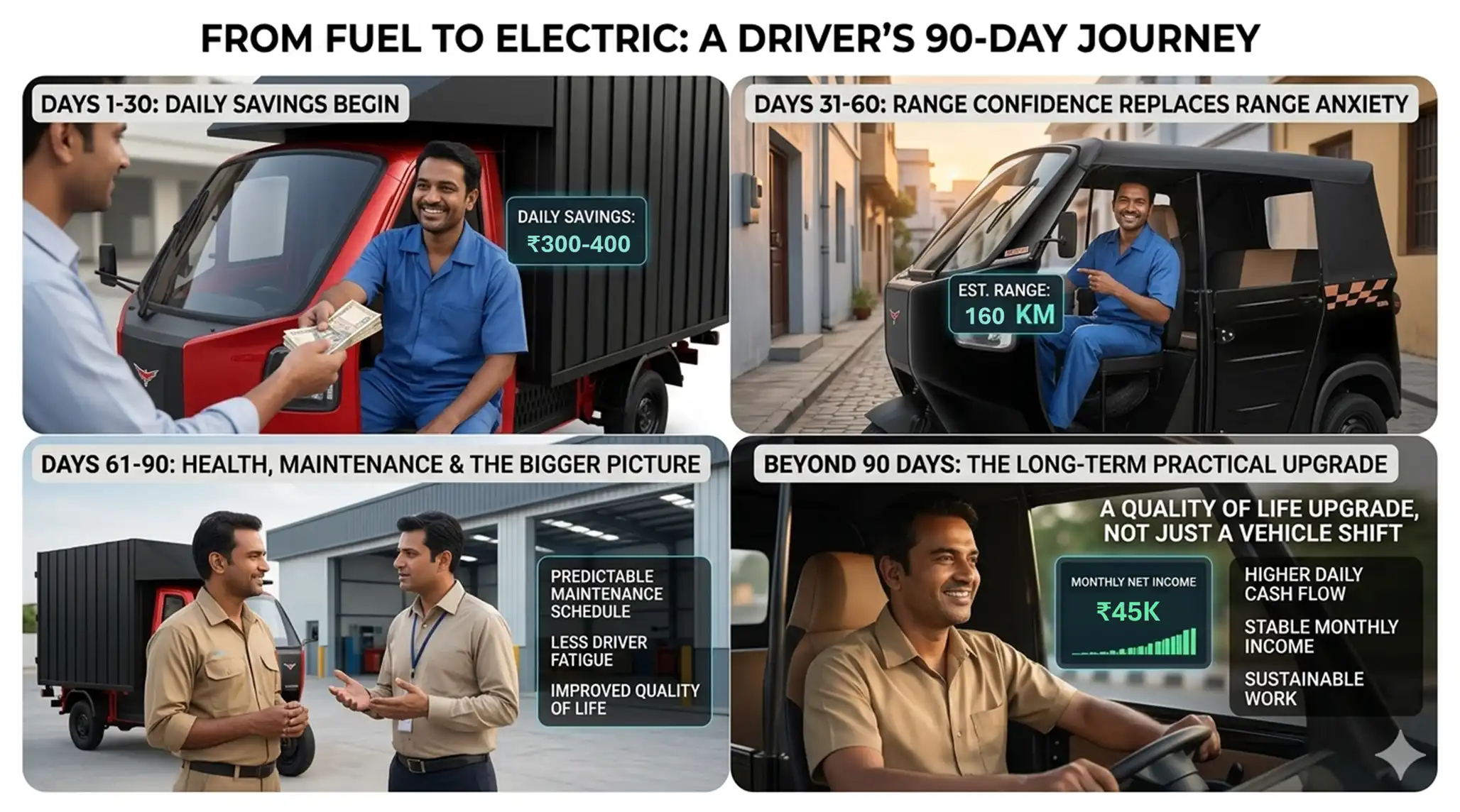
The first 90 days after switching to an electric auto reveal real changes for last-mile drivers. Lower daily energy costs, reduced physical fatigue, predictable maintenance and quieter workdays gradually replace fuel stress, making electric mobility a practical upgrade rather than just a technology shift.
Ask a driver who has switched from a diesel or CNG auto to an electric one what really changed, and you’ll rarely hear big words like sustainability or emissions. What you’ll hear instead is much simpler like “I don’t feel tired like before.”, “I’m not worried about fuel money anymore.”, “I don’t think I’ll go back.”
The first 90 days after making the switch are usually decisive. This is the period where curiosity turns into habit, and habit turns into preference. For most last-mile drivers, the transition to electric isn’t just about changing what powers the vehicle. It quietly reshapes how the day feels, how money flows and how much strain the body carries home at night.
The first few days are unsettling for experienced drivers. They are used to noise, they expect vibration and they instinctively wait for an engine response that never comes.
In an electric auto like the Montra Electric Super Cargo, the start-up moment feels almost broken at first. There’s no idle sound and no shaking seat. The vehicle simply moves when the accelerator is pressed. That silence takes getting used to, especially for drivers who’ve spent years judging engine health by sound alone.
The physical difference is immediate. Diesel and CNG autos transmit constant vibration through the chassis. Over long shifts, that vibration settles into the lower back, shoulders and knees. Drivers often don’t realize how much strain they’re carrying until it disappears. Within the first month, many report feeling less sore at the end of the day. Some talk about sleeping better. Others mention they no longer feel the need to stretch every time they stop.
Fuel is a daily pressure point. ₹300 to ₹400 a day spent on CNG or diesel isn’t abstract; it’s cash that leaves the pocket before earnings even begin. Switching to home or depot charging drops that daily energy cost sharply, often to ₹60–₹70. The remaining amount stays with the driver. Over 30 days, that difference adds up to roughly ₹9,000. It’s not saving in theory. It’s groceries, school fees or loan repayments handled with less stress.
The second month is when behaviour changes. Early on, most drivers obsessively check the battery indicator. They worry about getting stuck mid-route. That fear fades once real usage sets in. With a practical range that comfortably crosses a full working shift, drivers learn where the limits actually are and that those limits are rarely reached.
Routes settle into patterns. Drivers realize they don’t need to top up during the day. Overnight charging becomes routine. The vehicle starts every morning “full,” without detours to fuel stations or queues that eat into earning hours.
Traffic surprisingly becomes an advantage. Regenerative braking, which is something most drivers don’t think about at first, starts to work in their favour. Slowing down at signals or in congestion feeds small amounts of energy back into the battery. Over a full day in city traffic, this adds up.
There’s also time reclaimed. No more waiting at CNG stations during peak hours. No arguing with attendants. No calculating whether one more trip is worth the fuel stop. For many drivers, that saved hour becomes an extra trip or simply an earlier finish.
By the third month, the novelty is gone, and that’s a good thing. The electric auto has become normal. One of the most noticeable changes is what isn’t happening. There’s no clutch work and no constant left-leg movement. In dense traffic, clutch use can reach thousands of presses a day. Removing that repetitive motion reduces strain on knees and ankles, especially for drivers who’ve been on the road for a decade or more.
Maintenance expectations also reset. Around the 90-day mark, drivers accustomed to ICE vehicles would normally be thinking about oil changes, filter replacements or clutch adjustments. With an electric drivetrain, those visits simply don’t come up. Fewer moving parts mean fewer breakdown worries and fewer surprise expenses.
That predictability matters. When income is daily and margins are tight, avoiding unexpected garage bills can be just as important as saving on fuel.
There’s also a subtle shift in how the job feels socially. Passengers tend to be calmer in a quiet cabin. Conversations don’t require raised voices. The vehicle stays cleaner without exhaust residue. Drivers often say interactions feel more respectful. It’s not dramatic, but it changes the tone of the workday.
By the end of the first three months, most drivers stop comparing electric to fuel vehicles. The comparison feels settled. What starts as a financial decision becomes a quality-of-life upgrade. Drivers feel less worn down and cash flow becomes more predictable. The job feels more manageable over the long term.
That’s why, when asked if they would switch back, many don’t hesitate. Not because of technology trends or environmental arguments, but because the day simply runs better this way.
The first 90 days tell the real story of electric last-mile mobility. They strip away assumptions and replace them with lived experience.
For drivers, the shift isn’t about learning something new, it’s about unlearning years of compromise. Less noise, less vibration, fewer fuel worries, fewer service centers visits. More control over time and money.
Vehicles like the Montra Electric Super Cargo don’t just change how a city moves. They quietly change how a driver lives their working day. And once that difference is felt, it’s hard to imagine going back.
1. What is the biggest change a driver notices in the first month of switching to an electric auto?
The most immediate change is physical comfort. Drivers notice reduced vibration, less body fatigue, and quieter operation from day one. Many report feeling less sore at the end of the day and experiencing better sleep within the first 30 days of driving an electric auto.
2. How much money can a last-mile driver realistically save after switching to an electric vehicle?
Most drivers save ₹300–₹400 per day on fuel costs when switching from diesel or CNG to electric charging. Over the first 30 days alone, this can add up to around ₹9,000, directly improving daily cash flow without increasing working hours.
3. Does range anxiety remain a concern after using an electric auto for some time?
Range anxiety is common in the first few weeks but usually fades by the second month. Once drivers understand their real-world daily range and charging routine, overnight charging becomes enough for a full working day, and confidence replaces constant battery monitoring.
4. How does an electric auto reduce physical strain during long hours of city driving?
Electric autos eliminate clutch usage and reduce repetitive leg movement, which significantly lowers stress on knees, ankles, and the lower back. The absence of engine vibration further reduces long-term fatigue, especially for drivers operating in heavy traffic.
5. What long-term benefits do drivers experience by the end of the first 90 days?
By 90 days, drivers experience fewer maintenance concerns, no oil changes, lower service visits, and more predictable expenses. Combined with quieter cabins and smoother rides, the job feels less exhausting and more sustainable over the long term.

.svg)


.png)