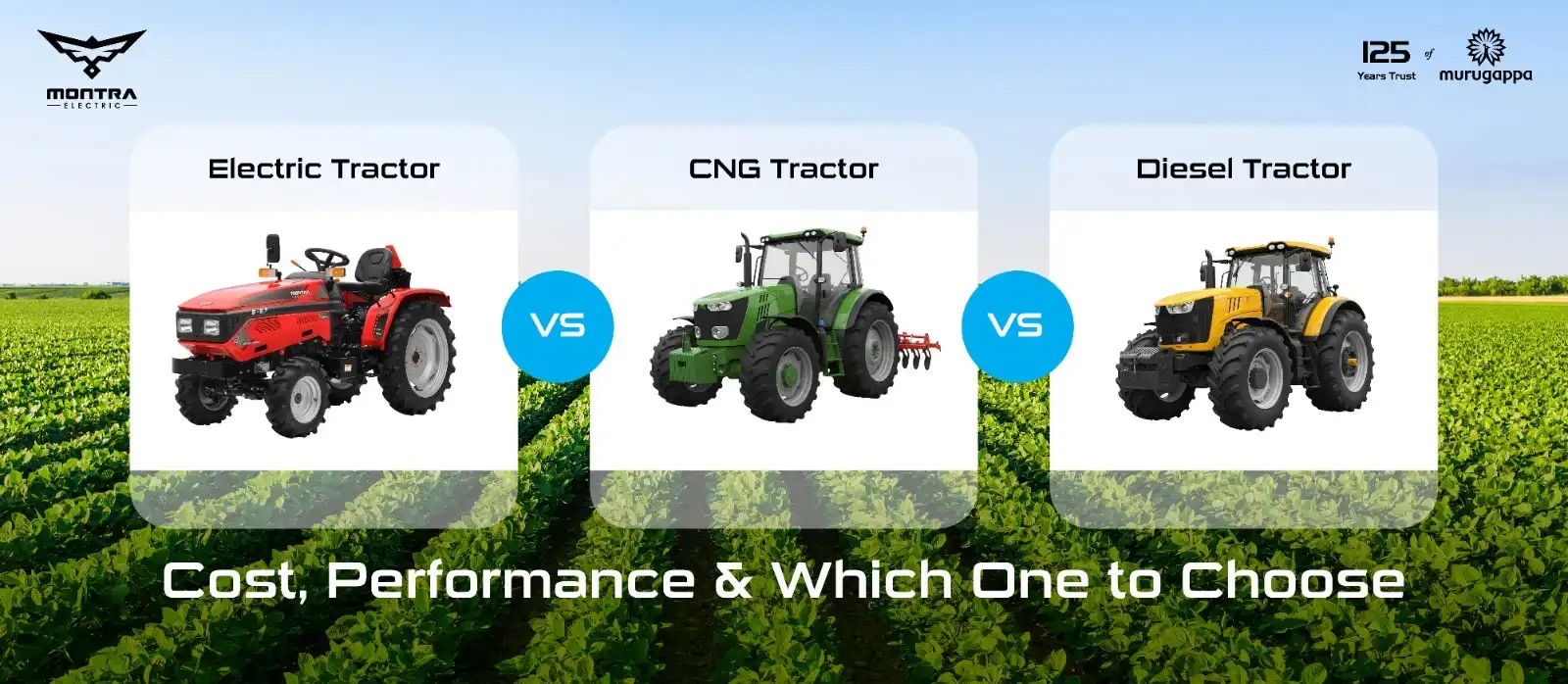
Agricultural operations across India face mounting pressure from volatile fuel costs, environmental regulations, and the need for sustainable farming practices. Traditional diesel tractors dominate the market while CNG alternatives offer partial solutions to emission concerns. Electric tractors have emerged as the transformative technology that addresses operational costs, environmental impact, and performance requirements simultaneously, representing the future of sustainable agriculture.
The economic transformation becomes immediately apparent when comparing daily operational expenses across all three powertrains. Fuel cost volatility affects both diesel and CNG tractors while electric operations remain predictably economical regardless of market fluctuations.
Electric tractor cost advantages include:
Diesel tractor operational challenges include:
CNG tractor limitations encompass:
Electric tractors eliminate fuel price anxiety while providing consistent operational economics that improve farm profitability across all crop cycles and seasonal variations.
Electric powertrains deliver superior torque characteristics perfectly suited for agricultural work patterns. Unlike diesel engines that require RPM buildup, electric motors provide maximum torque from zero RPM, enabling more efficient implement operation and field productivity.
Electric tractor performance benefits include:
Diesel tractor performance characteristics encompass power delivery that requires engine warm-up periods, torque curves that limit low-RPM efficiency, and noise levels that restrict early morning and late evening field operations.
The E27 Electric Tractor exemplifies optimal agricultural performance with 27 HP power, 90Nm torque, and 4-wheel drive capability, delivering reliable field operation with 22.37 kWh battery capacity and dual-speed PTO for versatile implement compatibility.
Agricultural sustainability concerns drive policy changes that increasingly favor zero-emission farming equipment. Electric tractors eliminate direct greenhouse gas emissions while supporting broader environmental goals that enhance farm certification and market access opportunities.
Progressive farmers adopting electric tractors position themselves favourably for future agricultural sustainability requirements while immediately reducing their environmental footprint.
Modern electric tractors incorporate sophisticated technology features that optimize agricultural operations beyond basic field work. Digital monitoring, precision control systems, and connectivity capabilities provide unprecedented agricultural efficiency and data collection opportunities.
Agricultural reliability demands equipment that performs consistently during critical planting, cultivation, and harvest periods. Electric powertrains demonstrate superior reliability compared to complex diesel engines or dual-fuel CNG systems.
Progressive agricultural operations investing in electric tractors secure competitive advantages through operational cost reductions, environmental compliance, and technological capabilities that traditional powertrains cannot provide.
Electric tractors represent the definitive evolution of agricultural mechanization, offering immediate economic benefits alongside long-term operational advantages.
1. Which tractor is the most cost-effective for Indian farmers: Electric, CNG, or Diesel?
Electric tractors are the most cost-effective due to significantly lower energy and maintenance costs. Electricity is far cheaper than diesel or CNG, and electric tractors have fewer moving parts, reducing long-term operating expenses.
2. Do electric tractors provide enough power for heavy agricultural work?
Yes. Electric tractors deliver instant torque from zero RPM, making them highly effective for ploughing, cultivation, hauling, and PTO-based operations. Models like the Montra Electric E27 offer strong torque and 4WD capability suitable for demanding farm tasks.
3. How do operating costs compare between electric, CNG, and diesel tractors?
Electric tractors can reduce daily operating costs by 60–70% compared to diesel tractors. While CNG tractors are cheaper than diesel in fuel cost, infrastructure limitations and maintenance complexity reduce their overall cost advantage.
4. Are electric tractors environmentally better than diesel and CNG tractors?
Yes. Electric tractors produce zero tailpipe emissions, helping farmers reduce carbon footprints and comply with future environmental regulations. Diesel emits high pollutants, while CNG only partially reduces emissions.
5. What maintenance advantages do electric tractors offer?
Electric tractors require minimal maintenance since they have no engine oil, fuel filters, or complex transmission systems. This results in less downtime, lower servicing costs, and higher reliability during critical farming seasons.
6. Is charging an electric tractor practical in rural areas?
Yes. Electric tractors can be charged using standard electrical connections, solar setups, or farm-based power sources. Unlike CNG, which requires refueling stations, electric charging is more accessible in rural farming environments.
7. Are electric tractors a future-proof investment for farmers?
Absolutely. Electric tractors align with evolving sustainability policies, rising fuel costs, and modern precision farming needs. With government incentives, lower operational expenses, and advanced technology integration, they represent a smart long-term investment.

.svg)


.png)