Feature Snippet
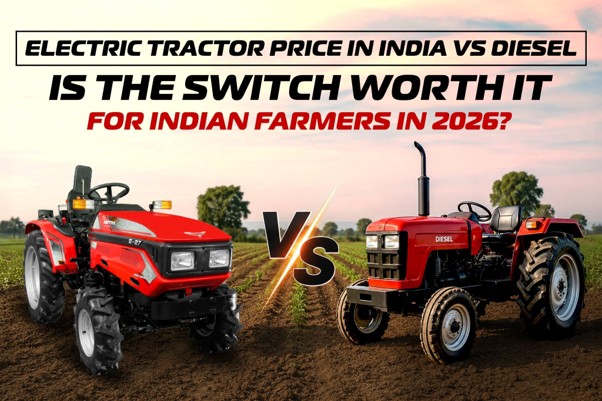
Yes, for small to medium-sized farms (up to 15 acres), the switch is highly beneficial. While the initial price of an electric tractor (₹6–11 lakh) is higher than diesel (₹4.5–6 lakh), the running costs are 50-60% lower, and maintenance savings can reach ₹50,000 annually. Most farmers can reach a break-even point within 3 years. However, for large farms (15+acres) requiring continuous heavy-duty work, diesel remains the more practical choice due to refueling speed and range.
The farming process in India has become increasingly dependent on costs with each passing season. Diesel rates cannot remain constant for a long time and any little rise affects the bottom line. The cost of maintenance is an ongoing issue that is usually overlooked and becomes burdensome eventually. Therefore, many people are considering the issue of electric tractors vs. diesel tractors. It is no longer a technological question; it is one of economy and efficiency.
It is actually very simple. Each person needs a different solution based on the size of their farms, usage and availability of electricity.
The first thing any farmer considers is the purchase price. The cost of an electric tractor currently in India would be from ₹6 lakh to ₹10 lakh depending on the model. However, in case of more sophisticated machines such as the Montra Electric E-27 tractor, the price range would be ₹10.5 lakh to ₹11 lakh. This, however, is compared to the price of a conventional 27-30 HP diesel tractor which could be ₹4.5 lakh to ₹6 lakh. So, at this point in time, the diesel tractor is more economical to own. But this is only the beginning of the story.
In small-scale farms, operations are scheduled. The tractor is used for some hours during the day and comes back home at night. It is easy to charge during the night in most instances. In this regard, the use of an electric tractor for agriculture becomes highly financially viable. The operating cost lowers significantly to about ₹200 per hour. In comparison, diesel rises to ₹450 per hour. This disparity accumulates substantially over time.
Maintenance cost reductions also play their part. Electric tractors have limited mechanical components and do not require periodic lubrication. This results in the saving of ₹30,000 to ₹50,000 annually. Although the Montra Electric E-27 incurs higher acquisition cost, this expenditure is recuperated within three years due to the savings mentioned above. After this period, the electric tractor begins cutting down on agricultural costs.
Daily advantages include noiseless operation, lower vibration levels and immediate torque.
For small farms, electric tractors are not just an alternative in fact it is a practical upgrade.
As farm size grows, the decision becomes more balanced. Work is not always the same, some days require light tasks, while others demand longer working hours. In this case, the comparison between electric tractor vs. diesel tractor depends on how the tractor is used.
Electric tractors like the Montra Electric E-27 still work well if:
However, diesel tractors still offer flexibility. They can run longer without stopping and can be refueled quickly, they also handle heavier implements better over long hours.
So for medium farms, the choice depends on your work pattern. If your operations are structured, electric vehicle can save money, but if your work is unpredictable and heavy, diesel may still be the better option.
The pressure on large farms is immense. There are many tasks to be done, time is precious and the tractors are required to work tirelessly without breaks. Under such circumstances, the diesel tractor has proved superior. It provides greater range, rapid refuelling and reliable operation even under the toughest conditions. Electric tractors, as of now, have their own shortcomings in this category.
Thus, in 2026, diesel will prove to be the better option.
Montra Electric E-27 is manufactured specifically for farmers who desire to save their running costs without affecting their performance. The tractor falls under the category of light to medium as it can be easily used for inter cultivation, orchards as well as transporting loads.
The tractor offers excellent performance; however, its most outstanding feature is that it saves the costs. It ensures that the running costs remain low and there are very few maintenance requirements. Those looking for an excellent electric tractor in India can opt for Montra Electric E-27.
The move away from diesel towards electric is inevitable, but this does not mean that all farms follow suit. The simple reason for which is that diesel is a better option based on the purchase cost. But once cost savings are taken into consideration over the years, it becomes apparent that electric tractors become an attractive alternative, particularly when considering small and medium-size farms.
Large farms still have their place in the world of diesel power in order to accomplish difficult tasks. Ultimately, the switch depends on each farm's compatibility.
Standard electric tractors cost between ₹6 lakh and ₹10 lakh, while advanced models like the Montra Electric E-27 range from ₹10.5 lakh to ₹11 lakh. This upfront cost is higher than diesel, but it is offset by long-term operational savings.
Electric tractors cut running costs by 50% to 60%, dropping hourly expenses to ₹150–₹250 compared to ₹400–₹500 for diesel. This drastic reduction helps farmers save significant money over the course of every harvest season.
Most farmers reach a break-even point and fully recover the extra upfront investment within 3 years. After this period, the massive savings on fuel and maintenance translate directly into higher farm profitability.
Large farms over 15 acres demand continuous, heavy-duty work that relies on quick refueling and long operational ranges. Diesel tractors remain the practical choice here because they do not require long charging breaks during time-sensitive tasks.
Because they have far fewer mechanical parts, electric tractors eliminate the need for regular oil changes and complex engine tuning. This simpler design lowers annual maintenance costs by ₹30,000 to ₹50,000.

.svg)


.png)