Featured Snippet
Electric tractors are becoming a viable alternative for Indian farmers primarily due to rising diesel prices and significantly lower long-term operating costs. While they are currently most effective for light-to-medium loads in horticulture and greenhouse farming, widespread adoption is still hampered by high upfront costs and limited rural charging infrastructure. However, with solar integration and "Tractor-as-a-Service" models, they offer a sustainable path for small and medium-scale agricultural operations.
The movement towards electric tractors in India has ceased to be merely a topic or an experiment. It is gradually manifesting itself on farms, in particular, in non-metro areas, where considerations are pragmatic, as opposed to trendy. The farmers are not moving away from their old ways simply because they crave innovation. On the contrary, they are forced to change as a result of the increasing cost of business.
Here, an electric tractor for farm use seems to be finally finding its niche. Of course, not universally and not in all operations, but definitely in some places.
The growing interest in an electric tractor in India is not driven by a single reason. It is the result of multiple practical factors coming together.
Even with these advantages, adoption remains limited. Farmers are cautious and there are clear reasons behind this hesitation.
It is imperative to note that there are certain activities that cannot be undertaken with this machine at this level of advancement. The strength of these machines comes out when they are being used for particular activities such as those requiring medium and predictable loads. They work best on farms of horticultural crops, on plantations, dairies and greenhouses. Activities such as spraying, row cultivation and transportation can be done using the electric tractor for farming since they require less energy.
On larger farms involving ploughing or extended working hours, the traditional diesel tractor continues to play a pivotal role.
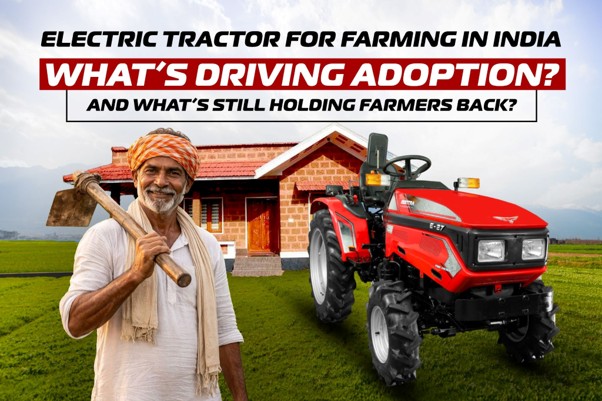
Success in the use of electric tractors is determined not only by the product, but also by the ecosystem of services around it. It is at this stage that the approach taken by the Montra Electric E-27 tractor comes into play.
In the first place, Montra Electric is concerned about building an extensive service infrastructure in remote and semi-rural regions. This will facilitate the service process, which will help build trust between customers and producers, reducing downtime in critical situations. Moreover, Montra Electric is developing its tractors according to practical needs. Instead of pursuing high specs, the company focuses on reliable performance and range of the tractors.
To solve issues related to pricing, the company seeks to develop flexible financial instruments and promote alternative schemes of usage. Besides, Montra Electric’s tractors fit perfectly well into the current trend of solar energy development.
The Montra Electric tractor combines several strengths in a single system that can benefit agriculture. It is cheaper to run than a diesel one. It is easier to maintain since there are less mechanical parts in the electric system. Also, it operates quietly, providing a good work environment. Although these factors individually might not have much effect, collectively they do bring about significant differences in agricultural practice. This could prove very helpful for small and medium farmers.
The future success of the development of electric tractors in India will depend on the changes that will occur within the system. The advancement of battery technology will improve the run time and effectiveness of the tractors. Prices might fall due to increased production. Financing will become easier to obtain. Charging will improve with a connection between electricity and solar energy. Service systems will be strengthened.
Though they cannot be said to be a full substitute for diesel tractors as of now, electric tractors can definitely serve as viable alternatives under certain circumstances. Their popularity is increasing steadily, driven by their economic benefits and novel application modes. While firms such as Montra Electric prioritize practicality over innovation, the switch from diesel to electricity appears feasible for Indian farmers. It might be a slow process, but it is certainly happening and electric tractors will definitely have a bright future ahead.
(FAQs)
Why are electric tractors becoming popular in India now?
Rising diesel prices have made farming costlier, pushing farmers toward more affordable alternatives. Electric tractors offer lower running costs, and solar-powered charging makes them even cheaper to operate. Flexible models like Tractor-as-a-Service have further improved accessibility for small farmers.
2. Can an electric tractor handle heavy-duty ploughing?
Electric tractors currently perform best for light-to-medium tasks like spraying, cultivation, and transportation. For heavy-duty work like deep ploughing or long operating hours, diesel tractors still hold the edge. However, improving battery technology is expected to close this gap in the coming years.
3. What is the biggest barrier to buying an electric tractor?
The high upfront cost remains the primary challenge, as electric tractors are priced higher than diesel models. Limited rural charging infrastructure and frequent power outages add to the hesitation. Underdeveloped financing options make it harder for small farmers to take the leap.
4. How does solar energy benefit electric tractor owners?
Farmers with existing solar setups for irrigation can use the same infrastructure to charge their tractors, cutting fuel costs to near zero. This makes solar-electric farming a highly sustainable and economical combination. It's especially advantageous in rural India, where sunlight is abundant year-round.
5. What should farmers expect from this technology in the next few years?
Battery improvements will enhance tractor range and performance, while increased production is likely to bring prices down. Financing will become easier to access, and charging networks will expand through solar integration. Overall, electric tractors will gradually become a practical option for a wider range of farming needs.

.svg)


.png)