India’s economic growth is being sparked from new geographies as rapid urbanisation continues to spread throughout the country, with cities expanding and absorbing neighbouring villages and smaller towns transforming into tier 2, 3 cities. Clearly, the benefits of urbanization and economic expansion has some drawbacks too, like the lack of last mile connectivity.
In order to encourage people to use public transportation instead of private vehicles, last-mile connectivity is a necessity. The economic and social needs of an expanding metropolis must be met by a robust public mass transit systems. Therefore, all efforts should be directed toward increasing ridership and facilitating commuters’ transition to their preferred mode of transportation. However, most cities face the issue of poor last-mile connectivity, where commuters are forced to use private vehicles, which exacerbates traffic congestion and lengthens commuting times and increases fuel consumption, leading to air pollution.
To address this chink in the armour, policymakers, regulators, and Indian OEMs now have a job at hand to quickly accept, adapt, and accommodate fresh and emerging forms of transportation and mobility services that are alluring, dependable, profitable, and most crucially sustainable. During the pandemic, owing to decreased movement of people, Indian cities had started to see clearer skies and fresher air. Now, it is essential that we figure out how to lower emissions and create greener cities in order to protect public health. This problem is much more pressing given that six of the world’s most polluted cities are located in India. The electrification of our transportation networks is a crucial solution because electric vehicles produce no on-road emissions.
A major shift in India’s clean energy policy can be seen in the country’s aggressive push for electric automobiles. Controlling pollution and seizing the initiative in a burgeoning industry appear to be the government’s two main goals. Also, to promote economic growth and support home-grown manufacturing, the government is also offering incentives for the production of electric vehicles and batteries as part of its Make in India initiative.
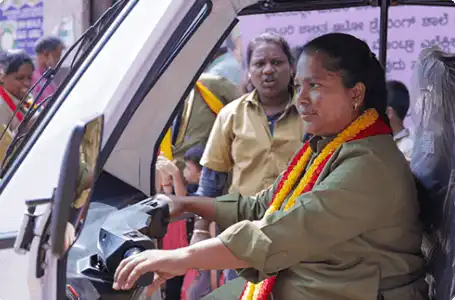
This is where electric three-wheelers fit perfectly. It has become more prevalent in India in recent years. Owing to its widespread popularity, the three-wheeler market is typically viewed as the low hanging fruit in the adoption of electric vehicles. It is positioned as an inexpensive way of intermediate public transit across short-to-medium distances.
The transportation industry is witnessing the most significant change in a century as a new generation of three-wheel electric vehicles (EVs) hit the streets and promise low cost, safety, security, and a lot of fun on three wheels, especially in metropolitan areas. In emerging nations like India, the number of electric auto-rickshaws has dramatically expanded during the past five years.
Riding the wave, it is now becoming imperative to embrace the change in a phased manner and replace auto-rickshaws that are powered by fossil fuels. The use of electric vehicles would contribute to a reduction in carbon emissions and urban noise pollution, as well as an improvement in air quality.
Also, electric three-wheelers are ideal at providing last-mile connection because they provide quick and affordable transportation services. In a country like India, last-mile transportation is driven solely by economics, which is why the cost difference is so significant.
Over the past few years, electric three-wheelers have become popular in many Indian cities, and with countrywide push from Indian OEMs for electric 3wheelers, India’s 3 wheeler revolution has already shown how it has the potential to become widespread zero emission option, and how the 3wheeler segment is driving the electric mobility revolution in India.
Additionally, it is anticipated that over the course of the forecast period, increasing support from the central and state governments, as well as their efforts to turn the automotive industry into a cleaner industry, will favourably impact the Indian market for electric three-wheelers. The increased affordability of electric three-wheelers is also anticipated to rise significantly in the next years.
However, in order to maximize the advantages of electrification, a supportive regulatory and conductive climate is required. This would entail setting up supporting infrastructure like e-three-wheeler stalls and charging stations, deciding on travel routes, and having a set of explicit rules for enforcement.
If electric 3 wheeler vehicles can find its proper place in the transportation solution and is deployed with the right intent, clean technological routes, and a zero emissions mandate, it can undoubtedly make a difference.
1. Why are electric three-wheelers important for Indian cities?
Electric three-wheelers help reduce urban air pollution by producing zero tailpipe emissions while addressing critical last-mile connectivity gaps in growing cities. They offer an affordable, clean alternative to fossil-fuel-powered transport in congested urban areas.
2. How do electric three-wheelers improve last-mile connectivity?
Electric three-wheelers provide quick, flexible, and low-cost transportation over short to medium distances, making it easier for commuters to reach metro stations, bus stops, and commercial hubs without relying on private vehicles.
3. What role do electric three-wheelers play in reducing pollution?
By replacing petrol, diesel, and CNG auto-rickshaws, electric three-wheelers significantly lower carbon emissions and noise pollution, helping improve air quality and public health in highly polluted Indian cities.
4. Why is the three-wheeler segment ideal for EV adoption in India?
The three-wheeler segment is considered the low-hanging fruit for EV adoption due to its short daily routes, high usage, cost sensitivity, and suitability for urban transport—making electrification both practical and economically viable.
5. How are government policies supporting electric three-wheelers in India?
Central and state governments are promoting electric three-wheelers through incentives, subsidies, and Make in India initiatives, encouraging local manufacturing and faster adoption of clean mobility solutions.
6. Are electric three-wheelers cost-effective for drivers and operators?
Yes, electric three-wheelers have lower running and maintenance costs compared to ICE vehicles, making them economically attractive for drivers while offering affordable fares for commuters.

.svg)


.png)