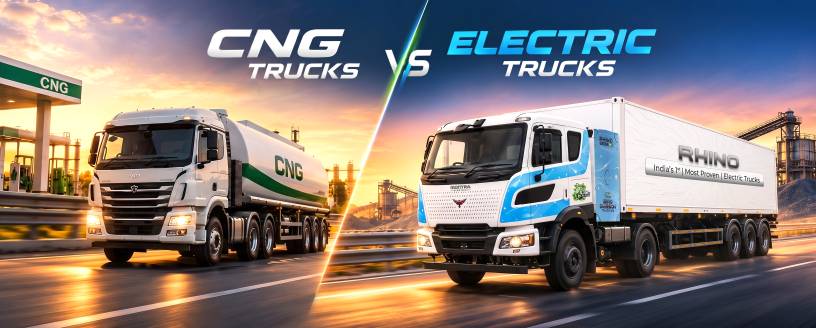
For most of the last decade, a fleet owner who wanted to move away from diesel had one realistic option: CNG trucks. They were cleaner, they were cheaper to fuel than diesel, and they used a driveline every mechanic already understood. That made CNG a sensible first step, and for city distribution and medium-duty routes it still is. Heavy industrial haulage is a different job. When the load is cement, clinker, coal or steel at a Gross Combination Weight of 55 tonnes, and the route is a fixed corridor run every day, the question is no longer which fuel is cheaper this month. It is which powertrain is built for that duty. This guide sets out how an operator should think it through, using the Montra Electric Rhino 5538 EV 4x2 Tractor Trailer as the electric reference point.
CNG trucks earn their place where refuelling is dependable and the duty is moderate. Fuel costs less than diesel per kilometre, the purchase price is lower than an electric truck, and service is available wherever a diesel truck can be serviced. In city distribution, or on a medium-duty run along a corridor with gas stations at both ends, that is a strong case.
The 55-tonne class is a different segment. These are heavy-duty tractor trailers working full loads on fixed industrial routes with high daily utilisation, and in this class gas-fuelled options are generally LNG-based rather than CNG, with their own refuelling needs to plan around. That is why the first step for a heavy-haulage operator is not to pick a fuel, but to define the duty: the load, the route, the gradients and the number of trips per day.
Energy is the largest running cost of a heavy truck, and the question is not only what it costs today but how steady it stays. Electricity, particularly when charging is set up at the plant or the depot, is contracted and predictable, and a truck charging on site does not queue at a fuelling point. An operator should ask for the energy cost per kilometre on his own route, at his own load, and then ask how confident the number is three years out.
A loaded tractor trailer is judged on the hill start, not the highway cruise. The Rhino 5538 EV 4x2 Tractor Trailer delivers 280 kW, which is 380 HP, and 2,000 Nm of torque from a Permanent Magnet Synchronous Motor, with 18% continuous gradeability and a 6-speed Automated Manual Transmission. An electric motor delivers its torque from standstill, so the driver is not managing a clutch and a narrow power band through repeated loaded restarts.
An electric driveline has far fewer moving parts than an engine-based one, and mechanical simplicity is where a large part of its uptime advantage comes from. Montra Electric backs the Rhino with 95%+ assured uptime. The vehicle is covered by an Annual Maintenance Contract, with a Premium Comprehensive Maintenance Contract available for 10 years or 9 lakh km. Advanced telematics show live location, route playback, battery health, temperature, voltage, SOC and kilometre detail, so fleet managers watch the vehicle rather than wait for it at the depot gate.
The Montra Electric Rhino 5538 EV 4x2 Tractor Trailer is a heavy-duty electric tractor trailer available with a 55-tonne (55t) Gross Combination Weight option, purpose-built for industrial applications such as cement, coal, steel, chemical and clinker movement. It runs a 282 kWh Lithium Iron Phosphate (LFP) battery paired with a Permanent Magnet Synchronous Motor, sits on a two-layer heavy-duty chassis frame with parabolic front and semi-elliptical rear suspension, and uses proven heavy-duty axles. The vehicle offers a range of 198* km on a single charge. Montra Electric also offers a 6x4 Tractor Trailer configuration with bogie rear suspension for heavier coupling loads and tougher gradients.
The cabin is designed around the fact that the driver is in it for a full shift: a walk-through layout, a sleeper berth, tiltable steering, a four-way adjustable seat and clutchless AMT driving, with low noise, vibration and harshness because there is no engine ahead of the cab. Drivers finish a loaded run less fatigued, which is an operational fact as much as a comfort one.
The purchase price of a heavy electric truck is the starting point, not the full cost. What matters to a fleet is the total cost of ownership: what it costs to move one tonne one kilometre over the years the truck is owned, with energy, maintenance, downtime and financing all counted.
Montra Electric makes that investment easier to plan. It offers lease and loan tenures of up to 10 years, operating lease and finance lease options, and a project funding facility that can include the charging infrastructure. Finance tie-ups span public sector banks, leading private banks, NBFCs and public sector energy finance companies, and the financing package also covers driver insurance. The practical takeaway: evaluate the complete package of vehicle, charging, maintenance and finance together, not the vehicle price alone.
Electric heavy trucks make their strongest case where routes are fixed, duty cycles are predictable and utilisation is high, because those three conditions let an operator place charging with confidence and recover the cost of the vehicle over a known annual running. Cement, coal and clinker movement fits that description almost perfectly, and the same logic extends to steel, mining, infrastructure and port haulage. Across its heavy-duty electric deployments in India, Montra Electric has 850+ vehicles on the road, 35Mn+ km covered and 6.5Mn CO₂ saved.
What is the Rhino 5538 EV built for? It is a heavy-duty electric tractor trailer with a 55-tonne GCW option, built for industrial haulage such as cement, coal, steel, chemical and clinker movement on fixed routes.
How should I estimate the running cost of a heavy truck? Ask for the energy cost per kilometre on your own route and at your own load, then look at maintenance, uptime and financing together as total cost of ownership. Contracted depot charging gives a predictable electricity cost.
Can an electric truck pull a full 55-tonne load on a gradient? The Rhino 5538 EV 4x2 Tractor Trailer is available with a 55-tonne GCW option and delivers 280 kW (380 HP) and 2,000 Nm of torque with 18% continuous gradeability.
What is the range of the Rhino electric truck? 198* km on a single charge for the Rhino 5538 4x2 Tractor Trailer, measured under standard test conditions on a one side loaded and one side empty cycle. Plan the route around your own load pattern rather than the headline figure.
How long does it take to charge the Rhino electric truck? 60 minutes from 20-100% SOC (State of Charge) on DC fast charging.
Except cement, what other industries can this vehicle operate in? Steel, mining, chemical, infrastructure and port haulage are the natural adjacent applications. The common requirement is a fixed route with predictable turnaround and high utilisation, not a particular commodity.
Planning a heavy industrial route? Talk to the Montra Electric heavy-duty team about route design, charging placement and duty cycle mapping for your corridor. Write to contactus@montraelectric.com or visit montraelectrictruck.com