


12 March, 2026 | Electric Three Wheelers
How Electric Autos Are Reducing Noise & Pollution in High-Density Indian Cities
By Montra Electric

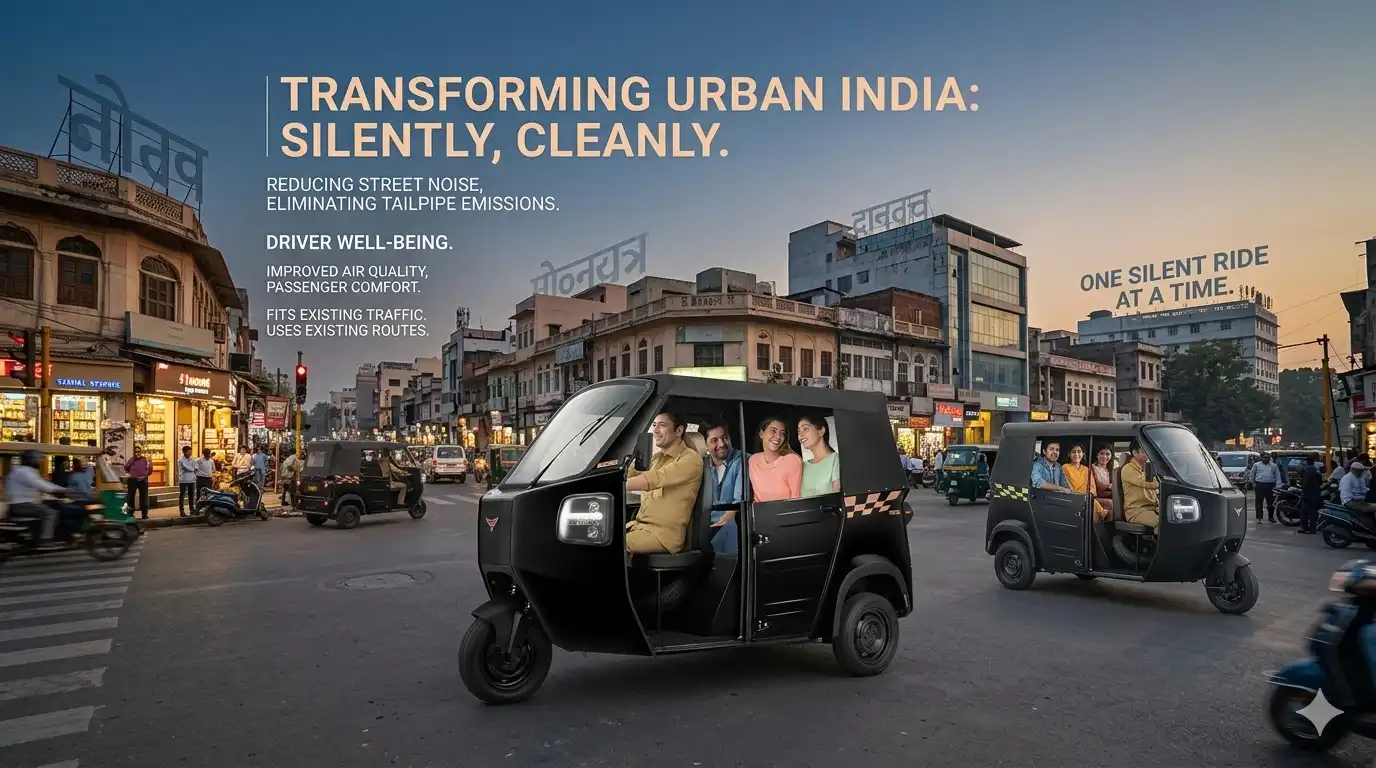
How Electric Autos Are Reducing Noise & Pollution in High-Density Indian Cities
Electric autos are transforming Indian cities by reducing street-level noise and eliminating tailpipe emissions. Unlike conventional auto-rickshaws, they operate silently in traffic and release no harmful exhaust, improving air quality, passenger comfort, and driver well-being in high-density urban areas.
Step off a main road in Old Delhi at peak hour or wait at a traffic light in central Bengaluru and one thing becomes immediately obvious: Indian cities don’t just look crowded, they sound exhausted too. For decades, the three-wheeler has been both a saviour and a stressor of urban mobility. Autos stitched cities together when buses couldn’t reach narrow lanes and taxis were unaffordable. But they also brought along a constant mechanical rattle, engine vibration, and a steady stream of exhaust fumes concentrated exactly where people live, walk, shop, and breathe.
What’s changing now isn’t just the fuel source. Electric autos are quietly altering how Indian cities feel at street level.
The Noise Problem We Learned to Ignore
Air pollution gets headlines. Noise pollution rarely does, even though its effects are just as real. In dense Indian cities, ambient noise at major junctions routinely crosses 85 decibels. That’s well above what health experts consider safe for prolonged exposure. The contributors are many like honking and construction, but conventional auto-rickshaws play a bigger role than we admit. Their engines idle loudly, vibrate continuously and amplify chaos at traffic signals where dozens line up together.
Electric autos remove one entire layer of that noise. There’s no engine clatter at standstill, no vibration resonating through the chassis, no revving to inch forward in traffic. In practical terms, that silence matters. Multiply it across hundreds of vehicles operating 12–14 hours a day, and the sound profile of a neighbourhood starts to soften.
For drivers, this is not a luxury, it's a relief. Long shifts without constant vibration reduce fatigue, headaches, and the ringing ears that many auto drivers accept as part of the job.
Cleaner Air Where It Matters Most
The emissions issue is more complex than just looking at the level of pollution, but we often downplay how much autos affect urban areas. Most auto use occurs within very highly polluted areas of cities, including highly congested roadway corridors, outdoor markets, Train Stations (Railway Terminus), and very busy residential areas. Even if an auto meets the regulated levels for exhaust emissions as defined by law, when operating in stop-and-go traffic, it will continue to emit nitrogen oxide (NOx) and particulate matter (PM) at our level of respiration.
Electric autos eliminate tailpipe emissions entirely. No NOx. No PM2.5. No exhaust plume lingering behind the vehicle as pedestrians cross the road. This is especially significant in Indian cities where exposure is local and continuous. For a commuter stuck behind an auto in traffic, the difference between an ICE vehicle and an electric one is immediate and physical. Cleaner air isn’t an abstract climate goal here, it’s a daily health benefit.
Passenger Mobility, Minus the Chaos
Electric passenger autos are also changing expectations inside the cabin. Take vehicles like the Montra Electric Super Auto now operating in multiple Indian cities. Built specifically for urban passenger movement, it pairs a quiet electric motor with a real-world range of around 160 km on a single charge which is enough for a full day’s work without range anxiety. Charging is typically completed within a few hours, fitting naturally into overnight downtime rather than interrupting earning hours.
What matters more than numbers though is how the vehicle behaves in traffic. Without a bulky engine, space inside the cabin improves. The ride is smoother because vibration from combustion is absent. Conversations no longer require raised voices. For passengers, especially women, senior citizens, and office commuters, this subtle improvement changes the perception of the auto ride from “tolerable” to “comfortable”.
Better Urban Transportation
Cargo Goes Quiet Too, the transformation isn’t limited to passenger movement. Last-mile logistics is already under pressure from e-commerce growth which has been a growing source of urban noise and emissions.
Electric cargo three-wheelers like the Super Cargo address this problem in a way that fits Indian operating realities. With payload capacity up to 580 kg and range of up to 160 km in daily use, they’re designed for multiple delivery runs without mid-day charging.
What’s notable is how unobtrusive they are. Early-morning deliveries no longer wake entire streets. Residential areas see fewer fumes from repeated loading and unloading stops. For businesses operating in dense neighbourhoods, quiet operation is becoming an advantage, not just a compliance checkbox.
Economics Is Doing the Heavy Lifting
Environmental narratives often fail when they rely on goodwill alone. Electric autos are succeeding because the math works. Lower energy costs per kilometre, fewer moving parts, and reduced maintenance translate directly into higher take-home earnings for drivers and lower operating costs for fleet owners. In a segment where margins are thin and daily cash flow matters, that’s the real accelerant.
This is why adoption is no longer limited to pilot programs or government tenders. Drivers talk to drivers. Fleet managers follow utilisation data. Once the economics prove themselves, change spreads organically.
Conclusion: A Different Kind of Urban Future
Electric autos won’t fix every urban transport problem. Congestion, road discipline, and infrastructure gaps still need attention. But they address two of the most immediate pain points which are noise and pollution, without demanding massive behavioural change from cities or citizens.
They fit into existing traffic. They use existing routes. They serve the same purpose as the autos they replace, just with far less collateral damage. The real impact of electric autos won’t be measured only in emission charts or decibel readings. It will be felt in quieter intersections, cleaner mornings, and drivers who end their day less worn down than before.
In a country where the three-wheeler is inseparable from city life, making it electric might be one of the most practical urban upgrades India has undertaken. Not loudly, not dramatically, but one silent ride at a time.
Frequently Asked Questions
1. How do electric autos reduce noise pollution in Indian cities?
Electric autos operate without engine combustion, eliminating idling noise, mechanical rattling, and vibration at traffic signals. When deployed at scale in dense urban areas, this significantly lowers ambient street noise.
2. Do electric autos really improve air quality at street level?
Yes. Electric autos produce zero tailpipe emissions, meaning no nitrogen oxides (NOx) or particulate matter (PM2.5) are released where people walk, wait, and breathe.
3. Are electric autos practical for full-day passenger operations?
Modern electric autos like the Montra Electric Super Auto offer real-world ranges of around 160 km, which is sufficient for a full day of passenger trips with charging done overnight.
4. How do electric autos improve comfort for drivers and passengers?
Electric autos provide a quieter, vibration-free ride that reduces fatigue for drivers and improves comfort for passengers.
5. Why are electric cargo autos gaining adoption in residential and commercial areas?
Electric cargo autos combine adequate payload capacity with quiet operation and zero emissions, making them ideal for last-mile deliveries in dense neighbourhoods.
Related Blogs

16 March, 2026 | Blog
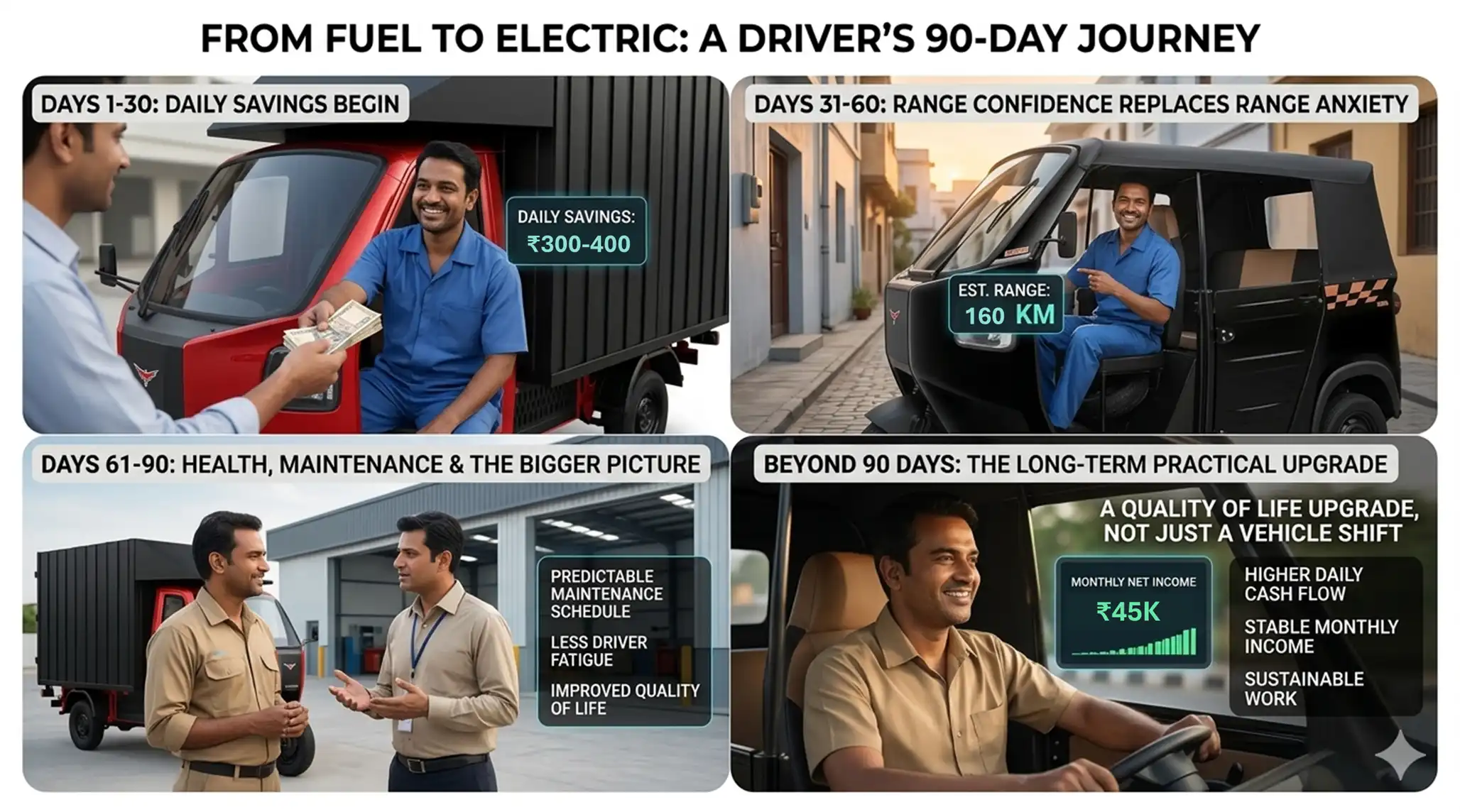
From Fuel to Electric: What Changes for a Last-Mile Driver in the First 90 Days?
The first 90 days after switching to an electric auto reveal real changes for last-mile drivers. Lower daily energy costs, reduced physical fatigue, predictable maintenance and quieter workdays gradually replace fuel stress, making electric mobility a practical upgrade rather than just a technology shift.
12 Mar, 2026 | Blog
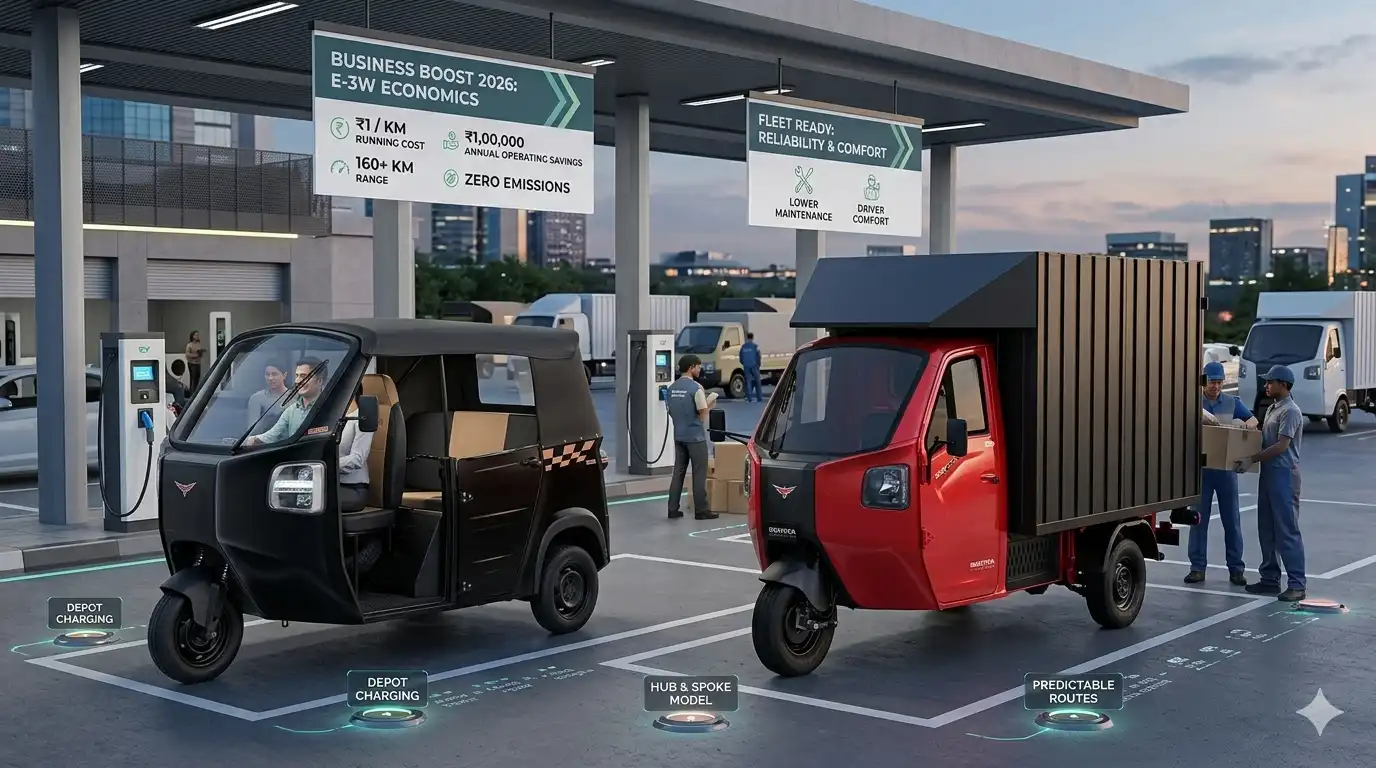
5 Reasons Businesses Are Switching to Electric 3-Wheelers in 2026
Businesses are increasingly switching to electric 3-wheelers in 2026 as the economics now strongly favor EVs. With per-kilometer costs under ₹1 and improved efficiency, new-age electric three-wheelers like the Montra Electric Super Auto and others offer over 160 km of real-world range, lower maintenance, and enhanced driver comfort, making them a practical and cost-effective alternative to traditional CNG or diesel vehicles.

Follow us on:


Service: 1800-833-3303
Sales: 1800-833-3301
Mail: customercare@montraelectric.com
Exports: exports@montraelectric.com
Grievance: ethics@ticm.murugappa.com