


16 Aug 2025 | Electric Vehicles
Top Electric Truck Trends: How Heavy Duty EV Trucks Are Shaping the Future of Transport
By Montra Electric Team


Feature Snippets
As freight demand grows and emissions targets tighten, electric trucks are moving from pilot fleets to commercial reality. For logistics operators, municipal fleets, and enterprise buyers, heavy duty electric vehicles promise lower operating costs, quieter operation, and regulatory alignment. However, they also demand new thinking around charging, uptime, and vehicle design.
Table of Contents:
- Why electric trucks matter for modern logistics
- Battery & powertrain advances driving heavy duty EV truck adoption
- Electric Truck Charging infrastructure: from depot fast-charging to megawatt hubs
- Design & durability: lessons from rugged commercial EVs
- TCO, downtime, and EV truck fleet economics
- Safety, telematics & smart fleet management
- Real-world use cases: urban delivery, intercity freight, and specialized haulage
- How fleet owners should evaluate an electric truck purchase
- Conclusion
Why Electric Trucks Matter for Modern Logistics
The economics driving light EV adoption, in the form of light passenger and commercial two, three, and four-wheelers, now extend to heavy trucks. Diesel accounts for a significant portion of operating expenses in medium- and long-haul fleets. Switching to electricity can almost immediately stabilize fuel costs and cut maintenance. Beyond cost, EV trucks reduce local emissions in cities, improve driver comfort with less vibration and noise, and position fleets for future low-emission zones and procurement preferences from large shippers.
Battery & Powertrain Advances Driving Heavy Duty EV Truck Adoption
At the heart of the heavy duty EV truck story is the battery capability of electric trucks. Electric trucks such as Montra Electric Rhino heavy commercial vehicle have innovated in EV technology to enable greater commercial viability.
- Higher energy density packs deliver competitive range for regional haul while keeping gross vehicle weight reasonable.
- Robust thermal management is now standard for heavy-duty duty cycles. Managing pack temperature under continuous heavy load preserves battery health and uptime.
- High-torque electric drivetrains provide instant torque needed for heavy loads and steep gradients while simplifying transmissions and reducing moving parts.
Practical buyers should focus less on headline range and more on usable energy under load, continuous discharge capability, and warranty terms that guarantee capacity retention over time.
Electric Truck Charging Infrastructure: From Depot Fast-Charging to Megawatt Hubs
Charging a single electric truck is straightforward. Charging an entire fleet is not. Several charging models are emerging:
- Depot fast-charging: High-power chargers at depots allow scheduled top-ups overnight or between shifts.
- Opportunity charging: Strategic top-ups during loading/unloading windows extend range without disrupting schedules.
- Megawatt charging hubs and public corridors: For intercity freight, megawatt-scale charging stations with ultra-high-power connectors reduce dwell time and enable longer routes.
- Vehicle-to-grid & smart charging: Coordinating charging with grid signals or renewable generation lowers energy costs and can qualify for favorable tariffs or incentives.
The right infrastructure mix depends on the route profile: urban delivery fleets often get by with depot charging and opportunity top-ups, while regional carriers will need access to corridor fast-charging.
Design & Durability: Lessons from Rugged Commercial EVs
Electric heavy vehicles operate in environments featuring highway speeds, heavy loads, dusty and wet conditions, and long daily operating hours. The following key vehicle design decisions enhance uptime:
- Reinforced chassis and full-metal frames reduce flex and improve longevity under payload.
- Ingress protection for electrical components (IP-rated enclosures) prevents dust and water from creating electrical faults.
- Modular, serviceable power electronics and battery packs shorten repair times and simplify part swaps.
- Simplified drivetrains with fewer moving parts lower routine maintenance and mean faster roadside fixes.
These engineering choices reduce unscheduled downtime and further enhance TCO benefits.
TCO, Downtime, and EV Truck Fleet Economics
When evaluating an EV truck price, fleet managers must shift from purchase price to TCO thinking. Electric trucks typically show savings in:
- Energy per km (especially with depot charging and favorable tariffs).
- Reduced maintenance spending (no diesel engines, fewer consumables).
- Lower vibration-related wear on chassis and bodywork.
Crucially, downtime is the most expensive line item for high-utilization fleets. A robust vehicle build, quick diagnostics, and local service networks transform a promising electric truck into a revenue-generating asset.
Safety, Telematics & Smart Fleet Management
Connectivity is a core asset when it comes to fleet management. Telematics platforms deliver battery state-of-charge, cell-level alerts, route optimization, predictive maintenance flags, and driver-behavior insights. Fleet dashboards let operators balance charging windows, plan preventive service, and dispatch vehicles based on residual range - reducing the risk of a truck being stranded mid-route. Safety systems such as regenerative braking and driver assist features also improve operational security and reduce accident-related costs.
Real-World Use Cases: Urban Delivery, Intercity Freight & Specialized Haulage
Electric truck adoption is accelerating in several applications:
- Urban last-mile delivery: Predictable return-to-depot cycles and high stop-start driving make electric trucks efficient.
- Intercity regional freight: With access to corridor fast-charging, medium-duty electric trucks can serve predictable regional routes.
- Specialized municipal and construction tasks: Sweepers, refuse trucks, and on-site haulers benefit from zero emissions and quieter operation.
Targeting these use cases lets fleets build experience and demonstrate the economics before wider rollouts.
How Fleet Owners Should Evaluate an Electric Truck Purchase
- Match continuous power & usable battery capacity to route duty cycles.
- Confirm local service coverage and spare-part availability.
- Validate battery warranty terms and replacement pathways.
- Choose a charging model (depot vs. corridor) and cost it into the TCO.
- Run a small fleet on representative routes to validate assumptions.
Conclusion
Heavy electric commercial vehicles are not a one-size-fits-all replacement for diesel fleets yet, but trends are converging quickly. With better battery packs, smarter charging ecosystems, rugged EV design, and rich telematics, the future of highway cargo transportation is being built one innovation at a time.
Frequently Asked Questions
-
1. What are the main benefits of electric trucks for logistics operators?
Electric trucks offer lower operating costs, quieter operation, reduced emissions, and alignment with future low-emission regulations. They also improve driver comfort by reducing noise and vibration. -
2. How far can heavy electric trucks travel on a single charge?
Range depends on battery size, load, and route conditions. Modern high-energy density packs can provide competitive regional haul ranges while maintaining reasonable payload capacity. -
3. What charging options are available for heavy electric trucks?
Common options include depot fast-charging, opportunity charging during loading and unloading, and megawatt charging hubs for intercity freight. -
4. Are electric trucks suitable for long-haul freight?
While best suited for urban and regional routes currently, advances in megawatt charging and battery technology are making long-haul electric trucking increasingly viable. -
5. How do electric trucks reduce downtime compared to diesel trucks?
With fewer moving parts, robust chassis design, and simplified drivetrains, electric trucks require less maintenance and can return to service faster after repairs.
Related Blogs


20 April, 2026 | Blog
How Electric Tractors Can Reduce Farming Costs for Small & Medium Farmers
Electric tractors help small and medium farmers reduce farming costs by lowering fuel expenses, minimizing maintenance and improving daily work efficiency. With government incentives and reliable performance, electric tractors offer a practical and affordable alternative to diesel machines for cost-effective agriculture.

16 March, 2026 | Blog
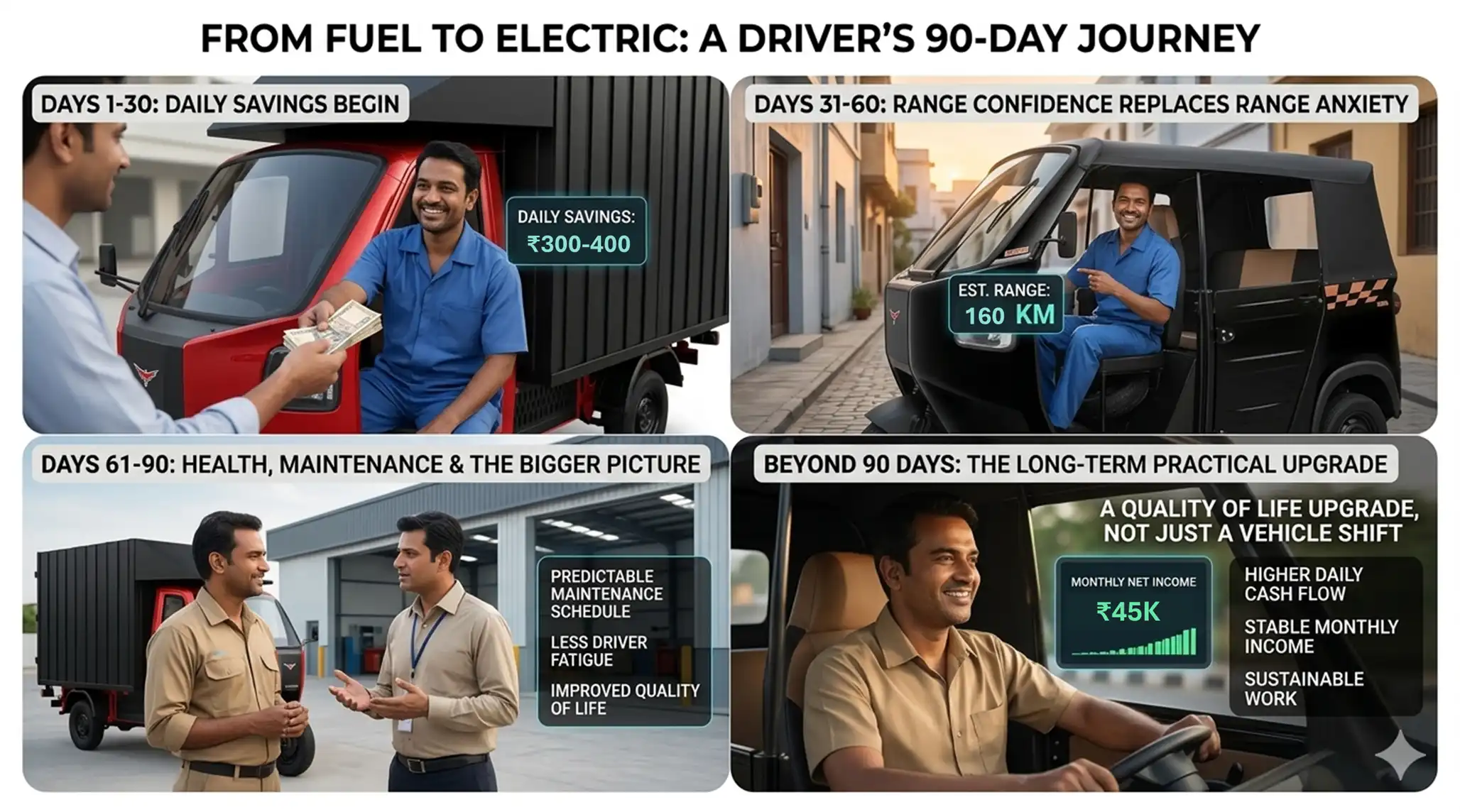
From Fuel to Electric: What Changes for a Last-Mile Driver in the First 90 Days?
The first 90 days after switching to an electric auto reveal real changes for last-mile drivers. Lower daily energy costs, reduced physical fatigue, predictable maintenance and quieter workdays gradually replace fuel stress, making electric mobility a practical upgrade rather than just a technology shift.

Follow us on:


Service: 1800-833-3303
Sales: 1800-833-3301
Mail: customercare@montraelectric.com
Exports: exports@montraelectric.com
Grievance: ethics@ticm.murugappa.com